China Top 4K to HDMI Cable Suppliers for Global Buyers?

Time:2026-10-25 Author:Oliver
0%

China has become a major sourcing base for reliable 4k To Hdmi Cable products. Global buyers can find manufacturers serving home entertainment, commercial displays, gaming, education, and professional AV markets. However, supplier selection requires more than comparing prices. A cable may look identical in photographs yet perform differently under continuous 4K transmission.

Experienced buyers usually examine bandwidth ratings, connector construction, shielding, jacket materials, and length performance. For 4K at 60Hz, an 18Gbps cable may be appropriate. For demanding 4K at 120Hz applications, buyers should consider certified HDMI 2.1 products supporting up to 48Gbps. Testing should cover signal stability, EDID communication, HDCP compatibility, and connector durability. Small details matter. A loose plug can interrupt a presentation.

The strongest Chinese suppliers provide samples, factory documentation, production traceability, and responsive technical support. They may also offer private labeling, custom packaging, and flexible order quantities. Still, polished catalogs do not prove manufacturing quality. Buyers should request test reports, certification records, and sample evaluations before placing large orders. This step is easy to overlook.

Supplier visits, video audits, and independent inspections can reveal practical conditions. Look for controlled assembly areas, repeatable testing procedures, and clear quality standards. Some suppliers communicate impressively but struggle with consistent delivery. That gap deserves attention. This guide examines leading China-based suppliers and compares their capabilities, product focus, customization options, and suitability for global purchasing. The goal is not to name one universal winner, but to help buyers make a careful, evidence-based decision.
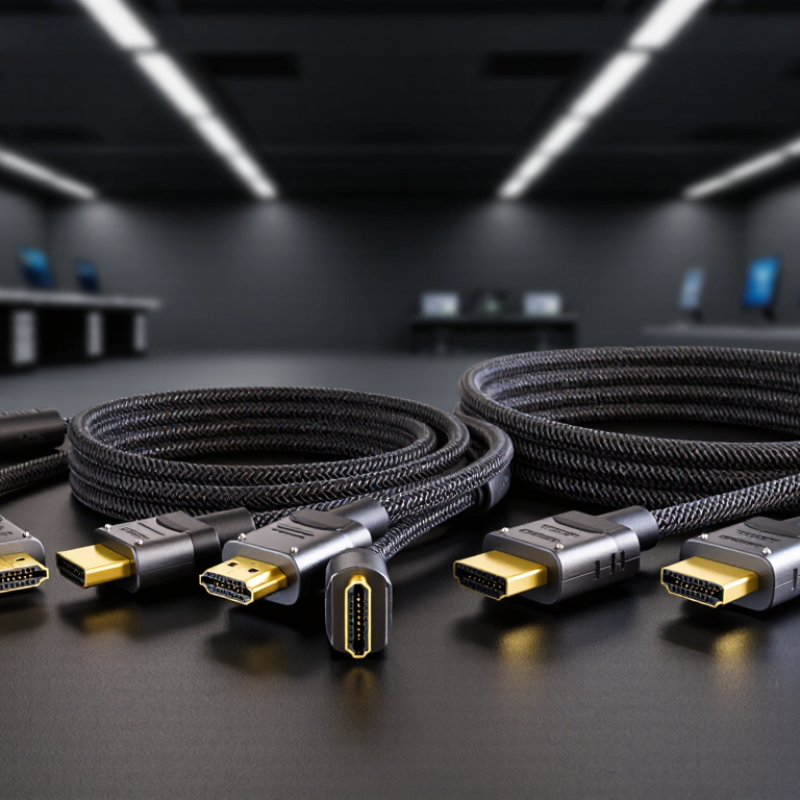
China Top 4K to HDMI Cable Suppliers for Global Buyers?

What Defines a Reliable 4K-to-HDMI Cable Supplier?

A reliable 4K-to-HDMI cable supplier proves performance beyond attractive packaging. CTA’s 2024 Consumer Technology Ownership and Market Potential Study indicates that 4K televisions are installed in more than six in ten U.S. households. Omdia’s 2024 television market analysis also shows 4K dominating larger-screen shipments. Demand is broad. Quality cannot be assumed.

The supplier should state bandwidth, conductor gauge, shielding structure, cable length, and supported refresh rates. HDMI 2.1 technical requirements allow up to 48 Gbps, but not every cable can sustain that rate. Ask for independent laboratory reports covering signal integrity, electromagnetic interference, bend cycles, temperature, and connector durability. Each report should show the test method, sample length, date, and laboratory identity. Vague “8K ready” claims are weak evidence.

Traceability matters. Reliable factories assign batch numbers, retain production samples, and test finished cables before shipment. They should provide compatibility results for different displays, sources, and receivers. A proper certification label helps, but it is not proof of every claimed performance level. I have seen packaging look stronger than the internal testing. That remains a practical warning. Request samples from several production batches, then repeat tests after bending and reconnecting the cable. Small failures often appear there. A dependable supplier also accepts reasonable technical questions and reports limitations honestly. That behavior signals professional maturity.

China’s Leading 4K-to-HDMI Cable Suppliers for Global Buyers

China’s leading 4K-to-HDMI cable suppliers serve global buyers through mature manufacturing clusters in Guangdong and Zhejiang. The strongest suppliers usually support OEM packaging, private labeling, and flexible order quantities. However, factory size alone proves little.

A reliable supplier should explain conductor material, shielding layers, connector plating, and jacket performance clearly. During sample reviews, I check cable length, bend recovery, plug fit, and image stability at 4K resolution. Small details matter. A loose connector can interrupt a presentation after several hours. Suppliers with in-house testing often provide signal, continuity, and durability reports before shipment. Buyers should request current documents, not copied files from old projects.

The top four supplier profiles are high-volume cable factories, engineering-focused manufacturers, export-oriented OEM suppliers, and smaller specialists with flexible customization. High-volume factories may offer lower prices, but communication can feel slow. Engineering suppliers often solve compatibility issues faster, though their minimum order quantity may be higher. OEM exporters simplify documentation and packaging, while smaller specialists can adjust molds or cable lengths quickly. One practical warning remains: a perfect sample does not guarantee perfect mass production. I once found inconsistent connector pressure in a bulk inspection, despite excellent samples. An independent pre-shipment check is worth the added cost. Ask about warranty handling, replacement procedures, and production lead times in writing. Clear records make supplier comparisons more reliable.

China’s Leading 4K-to-HDMI Cable Suppliers for Global Buyers

This chart compares commonly specified HDMI cable standards by maximum bandwidth and typical 4K refresh-rate capability. HDMI 1.4 supports up to 10.2 Gbps and 4K at 30 Hz, HDMI 2.0 supports up to 18 Gbps and 4K at 60 Hz, while HDMI 2.1 supports up to 48 Gbps and 4K at 120 Hz when compatible equipment and certified cables are used.

Key Product Standards and Technical Specifications to Compare

Global buyers comparing China-based 4K-to-HDMI cable suppliers should examine standards before unit price. The key question is simple: what signal must the cable carry? For 4K at 60 Hz, look for genuine 18 Gbps support. For 4K at 120 Hz, request evidence of 48 Gbps performance under HDMI 2.1 requirements. Confirm HDR, HDCP 2.2 or later, and eARC compatibility when needed. Do not accept “4K ready” as a complete specification.

Check conductor material, AWG, connector plating, shielding layers, and jacket flexibility. Longer cables need better loss control. A thin cable may work at two meters but fail at ten. Ask suppliers for eye-diagram results, bandwidth reports, and samples tested with your actual source and display. Certification should be verifiable, not printed decoration. Request inspection records and applicable RoHS or REACH declarations. Short samples help.

Reliable suppliers explain tolerances, bend limits, temperature ranges, and connector insertion cycles. They should identify whether active components or signal conditioning are used. Packaging must protect ports from dust and bent pins during export. Batch traceability matters when shipments show intermittent black screens. A higher bandwidth claim is not proof of better durability. Some buyers overlook return rates and replacement lead times. That mistake becomes expensive. Review performance after field testing, because laboratory success may not match long home-theater runs.

China Top 4K to HDMI Cable Suppliers for Global Buyers? – Key Product Standards and Technical Specifications to Compare
Comparison Dimension Recommended Benchmark for 4K Products Relevant Standard or Technical Basis What Global Buyers Should Verify Typical Application
HDMI Cable Category Premium High Speed Ultra High Speed Premium High Speed HDMI cables are intended for bandwidths up to 18 Gbps. Ultra High Speed HDMI cables are designed for bandwidths up to 48 Gbps. Request the correct official certification labeling and a test report for the specific cable model, not only a general company certificate. 4K60 systems; 4K120 and advanced gaming systems
Maximum Signaling Bandwidth 18 Gbps for HDMI 2.0-class products; up to 48 Gbps for HDMI 2.1-class products HDMI 2.0 supports a maximum data rate of 18 Gbps. HDMI 2.1 introduces Fixed Rate Link signaling with rates up to 48 Gbps. Check whether the quoted bandwidth applies to the complete cable assembly and whether the supplier can provide compliance or laboratory test evidence. 4K60, 4K120, high-refresh-rate displays, consoles and PCs
4K Resolution and Refresh Rate 4K at 60 Hz for mainstream products; 4K at 120 Hz for high-performance products 3840 × 2160 at 60 Hz is commonly used for 4K UHD systems. 3840 × 2160 at 120 Hz generally requires HDMI 2.1-class bandwidth and a suitable source, display and cable. Confirm the exact test format, including resolution, refresh rate, color depth and chroma subsampling. TVs, projectors, monitors, media players, gaming consoles and graphics cards
Color Sampling 4:4:4 at 8-bit for 4K60; 4:2:2 or 4:2:0 may be used where bandwidth is limited 4:4:4 preserves full horizontal and vertical color detail. The achievable combination of resolution, refresh rate, color depth and chroma format depends on available bandwidth. Ask for a test screenshot or analyzer report showing the advertised 4K format rather than accepting only a “4K compatible” claim. Computer text and desktop use, home theater and professional video
Color Depth 8-bit minimum for standard 4K; 10-bit support for HDR applications 10-bit video carries more tonal steps than 8-bit video and is commonly associated with HDR workflows. Higher color depth consumes additional bandwidth. Verify the complete supported mode, such as 4K60 10-bit, rather than listing “10-bit” as an isolated feature. HDR televisions, monitors, streaming devices and video production equipment
HDR Compatibility HDR10 pass-through; additional HDR formats depend on the source and display equipment HDR10 is an open HDR format commonly transmitted through HDMI systems. A cable normally passes the signal; HDR processing is performed by compatible source and display devices. Ensure the product description does not imply that the cable itself creates HDR. Verify signal pass-through under the intended resolution and refresh rate. 4K televisions, projectors, Blu-ray players and streaming devices
HDCP Support HDCP 2.2 for many 4K protected-content systems; HDCP 2.3 for newer HDMI 2.1 ecosystems HDCP is a content-protection system implemented across compatible source, display and intermediate devices. Cable construction alone does not independently provide HDCP functionality. Confirm that the complete signal chain supports the required HDCP version and test copy-protected 4K content with the intended equipment. Streaming boxes, UHD Blu-ray players, AV receivers and commercial displays
Variable Refresh Rate VRR support for compatible HDMI 2.1-class products HDMI 2.1 includes features such as Variable Refresh Rate, but successful operation also depends on the source, display, firmware and implementation. Request testing with the target console or graphics card and display combination. Do not treat a cable label as a guarantee of system-level VRR operation. Gaming monitors, televisions, PCs and current-generation consoles
eARC Capability Enhanced Audio Return Channel for compatible HDMI 2.1 systems eARC supports higher-quality audio return than the original ARC implementation, subject to compatible ports, devices and system configuration. Verify eARC pass-through using the intended TV, soundbar or AV receiver. The cable should be tested as part of the complete audio chain. Smart TVs, soundbars, AV receivers and home theater systems
Connector Type Standard Type-A male-to-male connectors for common consumer equipment HDMI Type-A uses 19 contacts. Other interfaces, including Mini HDMI and Micro HDMI, are physically different and require suitable cable designs or adapters. Confirm connector gender, shell dimensions, contact alignment, insertion fit and compatibility with recessed or wall-mounted ports. TVs, monitors, projectors, receivers, computers and gaming devices
Conductor and Shielding Design Oxygen-free copper or equivalent copper conductors with individually specified shielding layers Signal performance depends on conductor resistance, geometry, pair balance, insulation, drain design and shielding. Copper-plated aluminum should not be assumed equivalent to solid copper. Request the conductor material, conductor gauge, pair construction, foil/braid shielding details and continuity test results. Standard installations, long runs and electrically noisy environments
Cable Gauge and Length Gauge and maximum length should be specified for the claimed bandwidth Longer passive HDMI cables generally face greater attenuation and signal-integrity challenges. There is no universal maximum length for every design, data rate and installation condition. Compare each length separately and request a test report at the advertised bandwidth. For long distances, evaluate active, optical or signal-extending solutions. Short desktop connections, wall installations and conference-room systems
Active or Optical Design Use active copper or optical-fiber designs when passive copper length or bandwidth is insufficient Active and optical HDMI cables may include directionality, embedded electronics or optical conversion. They require correct source-to-display orientation where specified. Check directional markings, power requirements, minimum source output, bend radius, connector construction and compatibility with AV equipment. Long-distance 4K distribution, digital signage, classrooms and commercial AV
EDID and CEC Pass-Through Stable EDID communication and CEC pass-through where required EDID allows the display to communicate supported modes to the source. CEC enables control functions between compatible HDMI devices. Test hot-plug behavior, resolution negotiation, input switching, sleep/wake recovery and CEC control with the target equipment. AV receivers, switchers, docking stations, conference systems and home theaters
Mechanical Durability Strain relief, secure overmolding and connector retention suitable for the installation environment Repeated bending, pulling and connector loading can damage conductors or solder joints even when the cable initially passes a signal test. Review bend-cycle, pull-force, insertion-cycle and connector-retention test methods. Confirm the minimum bend radius and jacket material. Retail packaging, frequent-use installations, rack systems and fixed installations
EMC and Signal Integrity Controlled impedance and verified electromagnetic compatibility performance HDMI high-speed differential pairs require controlled electrical characteristics. Poor impedance control or inadequate shielding can cause intermittent video, sparkles or handshake failures. Request eye-diagram, insertion-loss, return-loss, crosstalk and electromagnetic compatibility test evidence where applicable. High-density equipment racks, offices, broadcast areas and industrial environments
Material and Chemical Compliance RoHS and REACH documentation for applicable destination markets RoHS restricts specified hazardous substances in covered electrical and electronic products. REACH addresses chemical substances in the European Union supply chain. Request a current declaration of conformity, material declaration or laboratory report covering the exact product and components. European Union and other markets requiring restricted-substance documentation
Packaging and Traceability Model-specific labeling, lot identification and technical documentation Traceable packaging helps buyers connect the shipped cable to its declared specification, test report and production batch. Check model number, length, cable category, production lot, country-of-origin information, warranty terms and barcode consistency. Import distribution, private-label programs and project procurement
Pre-Shipment Quality Control 100% continuity testing plus sample-based high-speed performance testing Continuity testing can identify open or short circuits, but it does not prove high-speed signal performance. Bandwidth and interoperability tests are also required. Request the inspection plan, sampling level, failure criteria, test equipment and retained test records for each production lot. OEM orders, wholesale distribution and large-volume international shipments

How to Evaluate Quality, Compatibility, and Certification

China Top 4K to HDMI Cable Suppliers for Global Buyers?

For global buyers, cable quality starts with measurable performance, not a thick jacket or attractive packaging. A 4K 60Hz connection generally needs 18 Gbps bandwidth, while 4K 120Hz may require up to 48 Gbps. MarketsandMarkets reported that the HDMI cable market is expanding with rising demand for high-resolution displays and gaming equipment. Buyers should request bandwidth test results, connector-plating details, conductor specifications, and bend-cycle records. A cable that works at one meter may fail at five meters.

Compatibility requires closer inspection. Check the source, display, refresh rate, HDR format, audio return channel, and cable length together. The HDMI Licensing Administrator states that certified Ultra High Speed HDMI cables must pass compliance testing and use approved labeling, including a certification label and QR verification process. Certification matters. However, it does not replace system testing in the buyer’s actual environment. Long passive cables can lose signal quality, especially near maximum bandwidth. Active or optical designs may help, but they introduce electronics and require stricter quality control.

Certification documents should be current, traceable, and matched to the exact product model. ISO 9001 supports manufacturing consistency, yet it does not prove 4K signal performance. Independent laboratory reports are stronger evidence. Ask for eye-diagram results, electromagnetic compatibility tests, and samples from regular production. One overlooked issue is packaging accuracy. A cable marked “8K” may not clearly state its tested bandwidth or length. That gap deserves questions, not assumptions. Supplier evaluation is never perfectly clean; even a careful checklist can miss a batch-level defect.

OEM, Pricing, Shipping, and Supplier Selection Considerations

Global buyers usually evaluate Chinese 4K HDMI cable suppliers through OEM flexibility, pricing, shipping, and quality evidence. A factory should explain conductor material, shielding, connector construction, and supported resolution clearly. Ask for a sample before discussing large volumes. Test it early.

OEM projects may include custom lengths, connector colors, packaging, labels, and molded designs. Confirm minimum order quantities and tooling fees in writing. A lower unit price can hide weaker materials or incomplete testing. Request reports for bandwidth, signal stability, bend resistance, and connector durability. Test cables with actual televisions, projectors, and source devices. That matters.

Shipping requires more than a freight quotation. Confirm carton dimensions, gross weight, production time, export documents, and delivery terms. Air freight may suit urgent samples, while sea freight reduces cost for repeated orders. Keep records. Supplier selection should also consider response speed, replacement procedures, inspection support, and payment safeguards. One practical mistake is accepting attractive photos as proof of production capability. A factory visit, live video inspection, or independent pre-shipment check provides stronger evidence. Requirements can change after testing, so leave room for design adjustments and realistic delivery delays.

FAQS

What bandwidth should a 4K cable support?

A 4K 60Hz connection generally needs 18 Gbps. A 4K 120Hz setup may require 48 Gbps. Ask for measured test results, not packaging claims.

Why does cable length affect performance?

A one-meter cable may work perfectly. The same design can fail at five meters. Long passive cables may lose signal quality near maximum bandwidth.

What compatibility details should buyers check?

Check the source device, display, refresh rate, HDR format, audio return, and cable length. Test them together. A cable can pass one setup and fail another.

Does certification prove that a cable will work everywhere?

No. Certification shows that the exact model passed required compliance testing. It does not replace testing with your television, projector, and source device. Real systems behave differently.

Which documents should a supplier provide?

Request current documents matched to the exact product model. Useful evidence includes bandwidth reports, eye-diagram results, and electromagnetic compatibility tests. Independent laboratory reports are stronger.

Is a quality-management certificate enough?

No. It supports manufacturing consistency. It does not prove high-resolution signal performance. That distinction is easy to miss.

What should buyers inspect in an OEM project?

Confirm custom length, connector color, packaging, labels, and molded designs. Record minimum order quantities and tooling fees in writing. Small details become expensive later.

How can buyers avoid choosing a supplier from attractive photos?

Request samples before placing a large order. Use a live video inspection, factory visit, or independent pre-shipment check. Photos prove very little.

What shipping information should be confirmed?

Confirm carton size, gross weight, production time, export documents, and delivery terms. Air freight suits urgent samples. Sea freight usually reduces repeated-order costs.

What is a practical weakness in supplier evaluation?

Even a careful checklist can miss a defective batch. Keep room for retesting and design changes. The process is useful, but not perfect.

Conclusion

Choosing a reliable 4k To Hdmi Cable supplier in China requires more than comparing prices. Global buyers should assess manufacturing experience, product consistency, quality-control procedures, and the supplier’s ability to support stable large-volume orders. Leading suppliers typically offer cables designed for high-resolution video, dependable signal transmission, suitable bandwidth, durable connectors, and compatibility with televisions, monitors, projectors, gaming systems, and other modern devices. Clear technical specifications, production samples, testing records, and recognized compliance documentation can help buyers reduce compatibility and performance risks.

Buyers should also compare support for OEM customization, packaging options, minimum order quantities, lead times, payment terms, and shipping arrangements. A professional supplier should communicate specifications accurately, provide transparent quotations, and respond efficiently to technical or production questions. Before placing a large order, it is advisable to evaluate samples, confirm certification details, inspect workmanship, and establish clear acceptance standards. By balancing quality, compatibility, certification, pricing, logistics, and after-sales communication, global buyers can select a dependable long-term supply partner.


Oliver

Oliver

Oliver is a seasoned marketing professional with a wealth of expertise in driving brand awareness and engagement. With a deep understanding of our company's product offerings, he consistently delivers high-quality content that enriches our professional blog. His insights not only shed light on......